Blog
Food Commerce
The Complete Guide to Selling Catch-Weight Products on Shopify
Learn how food merchants can sell catch-weight products on Shopify using estimated weights, payment authorization, final weighed pricing and purpose-built fulfillment workflows.
Grocerist

If you sell fresh meat, seafood, produce, deli products, cheese or other variable-weight foods, you have probably encountered one of Shopify’s most important limitations for food retail.
How do you sell a product when its final price is not known until it is picked and weighed?
This is the core challenge of catch-weight ecommerce.
Shopify is an excellent commerce platform. But selling products by variable weight requires specialized product data, payment handling and fulfillment workflows that standard ecommerce stores do not typically need.
With the right solution, food merchants can still use Shopify while giving customers an experience that feels as natural as buying the same product at a grocery store, butcher counter or seafood market.
What Is Catch-Weight?
Catch-weight refers to products whose exact weight varies from one item to another.
A customer may choose a product using an estimated size, quantity or price. The actual weight—and therefore the final selling price—is confirmed only after the product is selected and weighed during fulfillment.
Common catch-weight products include:
Fresh steaks, roasts and ground meat
Whole chickens and turkeys
Fresh and frozen seafood
Cheese and deli products
Fresh produce
Bulk foods and dried goods
The variation is not a defect. It is simply part of selling fresh food. The ecommerce experience has to account for it.
Why Catch-Weight Is Challenging on Shopify.
Shopify is designed primarily around products with a known selling price at checkout.
For most retail categories, that works perfectly. Food merchants operate differently.
A customer may order a ribeye steak with an estimated weight of two pounds. The steak selected by the fulfillment team may weigh 2.18 pounds—or 1.86 pounds.
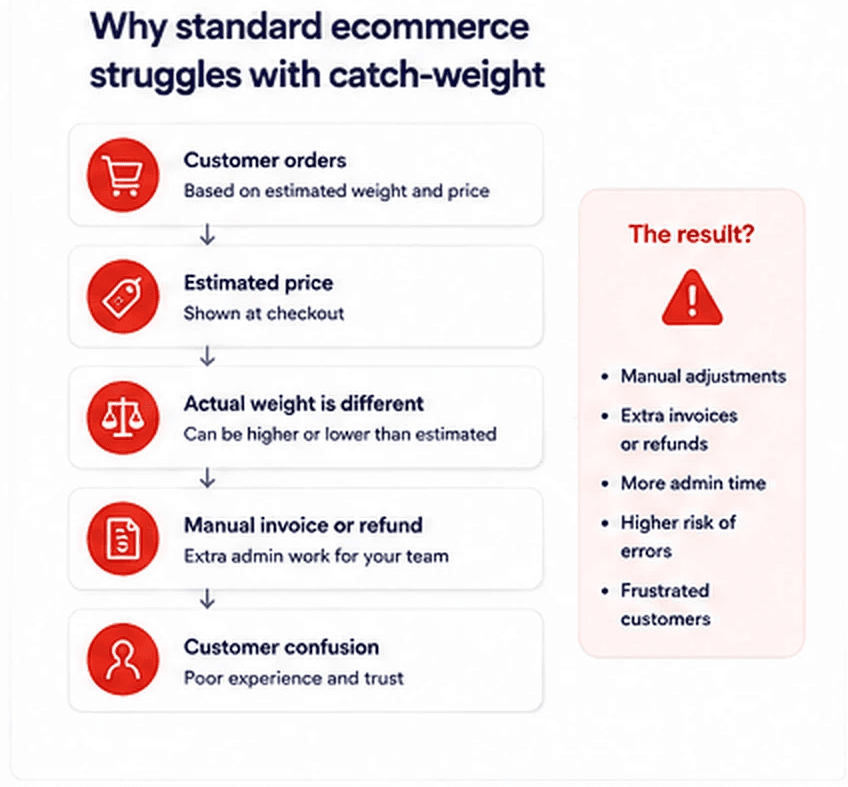
The customer should pay for the product actually received, rather than an arbitrary estimate. That creates several operational questions:
How should the product be displayed online?
What estimated weight should be used?
How much should be authorized at checkout?
How does the picker record the actual weight?
How is the final price updated?
How are substitutions and price differences handled?
How is the completed order recorded in Shopify?
Without a purpose-built workflow, merchants often create manual processes that increase staff effort and produce a confusing experience for customers.
Common Approaches Merchants Try:
Sell only fixed-weight packages
Potential advantage: Easy to price and display online
Limitations:Requires additional packaging and labour
Can reduce merchandising flexibility
May create waste or limit customer choice
Charge an estimate and make manual adjustments
Potential advantage: Can work with a standard ecommerce setup
Limitations:Creates refunds or additional invoices
Adds bookkeeping and customer-service work
Introduces more opportunities for errors
Sell products “by each” without reconciling actual weight
Potential advantage: Simple for the customer
Limitations:Can reduce margin accuracy
May produce inconsistent value for customers
Does not work well for high-value variable-weight products
Build a custom solution
Potential advantage: Can be tailored to the merchant’s operation
Limitations:Can be expensive to build and maintain
Requires ongoing development expertise
May become difficult to update as Shopify evolves
How Grocerist Enables Catch-Weight on Shopify:
Grocerist extends Shopify with the product data, customer experience, payment workflow and fulfillment tools required by food merchants.
The process begins before the first online order is placed.
Preparing Product Data for Ecommerce
Grocerist works with each merchant to review the products sold by weight in-store and determine how they should be presented and fulfilled online.
Existing POS data is enhanced with the information required for ecommerce, which may include:
• Average selling weight
• Selling unit and weight increment
• Customer-facing product names and descriptions
• Product imagery
• Online merchandising details
• Pricing relationships between estimated and actual weight
Grocerist also maintains a library of standard fresh, frozen and dried food products. This includes product images, average selling weights and other data that can help merchants prepare their catalogues more efficiently.Supporting Different Ways to Sell
Not every variable-weight item should be sold in the same way.
Grocerist can support products sold using average-weight increments. For example:
• A one-pound package of ground beef
• An eight-pound turkey
• A two-pound roast
Products can also be sold by each when that produces a simpler buying experience.
For example, a Gala apple could be presented as $1 each based on an average pick weight of approximately half a pound and the merchant’s price per pound. The customer shops in familiar units while the required weight and pricing information remains available behind the scenes.Presenting Catch-Weight Products Cleanly in Shopify
Grocerist installs its catch-weight solution within the merchant’s Shopify environment.
The additional product data required to support variable-weight selling is configured so that the customer sees a clean, understandable product page rather than operational complexity.
Customers can understand what they are ordering, the estimated quantity they should expect and how the final price will be determined.Authorizing Enough Payment Flexibility
The actual weight of a catch-weight item may be slightly higher or lower than its estimated weight.
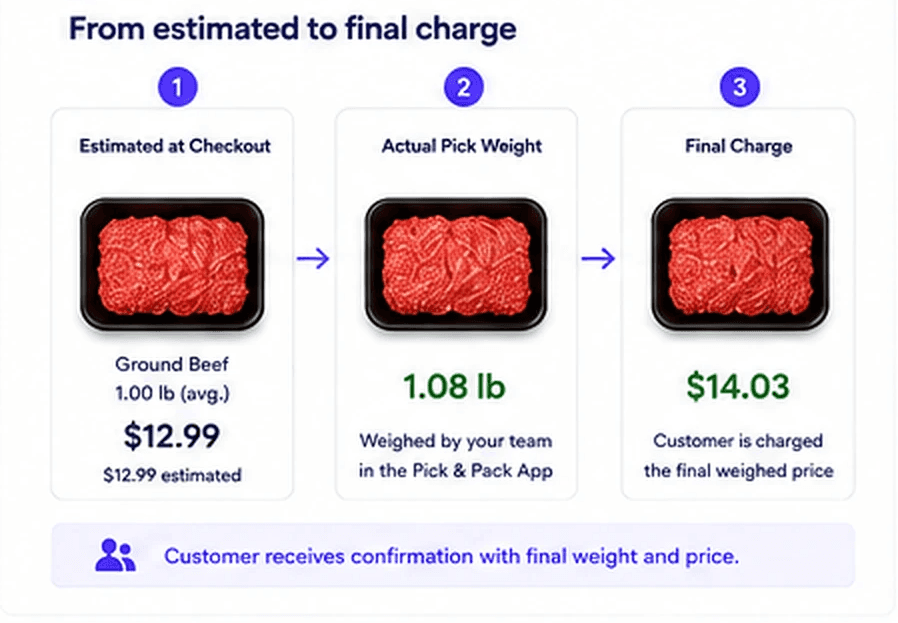
Grocerist supports a payment pre-authorization workflow that includes an appropriate temporary buffer. This allows the fulfillment team to select the best available item without requiring a second checkout when the actual weight is modestly above the estimate.
The temporary authorization is not the customer’s final charge. The final payment is captured after the products have been picked, weighed and adjusted.Weighing and Adjusting Products During Fulfillment
Grocerist’s proprietary fulfillment application gives the pick-and-pack team a simple process for handling catch-weight items.
As the order is picked, staff can:
• Identify each catch-weight product
• Weigh the selected item
• Enter its actual weight or value
• Automatically update the price
• Continue through the remainder of the order
Once all catch-weight products have been confirmed, the customer’s card is billed for the final weighed amount—similar to how the transaction would be completed at a point of sale.

Handling Product Substitutions
Substitutions are another normal part of food retail, especially when merchants sell fresh products or operate with frequently changing inventory.
Using the Grocerist fulfillment application, the merchant can replace an unavailable product with an appropriate substitute.
Any difference in price can be calculated before the customer’s final payment is captured.
This means an overage does not require the merchant to send a new invoice or ask the customer to complete another transaction.
The operations team does less manual work, while the customer receives a much smoother buying experience.

The Benefits for Food Merchants.
A purpose-built catch-weight workflow does more than solve a technical problem. It removes friction from the entire ecommerce operation.
Accurate final pricing based on the products actually delivered
Fewer manual refunds, invoices and payment requests
A faster workflow for pick-and-pack teams
A more transparent experience for customers
Cleaner order records in Shopify
Support for both variable-weight products and substitutions
The ability to use Shopify without giving up food-retail functionality
When Native Shopify May Be Enough.
Not every food merchant needs catch-weight functionality.
Native Shopify may be sufficient when the merchant sells only fixed-price products such as packaged snacks, beverages, shelf-stable grocery items or prepared products with consistent sizes.
Additional capabilities are more likely to be required when the catalogue includes fresh meat, seafood, produce, cheese, deli products, bulk foods or other items whose actual selling price depends on the weight picked.
Catch-Weight Should Not Prevent You from Choosing Shopify.
Shopify provides food merchants with a reliable, scalable commerce platform and a broad ecosystem of payment, marketing and operational tools.
The challenge is not that Shopify is the wrong platform. The challenge is that food retail has specialized requirements that most ecommerce businesses do not encounter.
Grocerist fills that gap by combining Shopify with the product data, payment logic and fulfillment workflows required to sell variable-weight food effectively.
Final Thoughts.
Selling catch-weight products online should not require manual calculations, customer callbacks or a collection of disconnected workarounds.
With the right preparation and operational workflow, variable-weight products can be sold online almost as naturally as they are sold at a grocery store, butcher counter or seafood market.
Grocerist gives food merchants the benefits of Shopify while supporting the real-world complexity of fresh-food ecommerce.
Ready to sell catch-weight products on Shopify?
Book a demo with Grocerist to see how the complete workflow operates inside a Shopify store.
Grocerist
Share