Beyond the Storefront: The Operational Data Challenge Behind Modern Ecommerce
AI is becoming a place where customers can discover products and shop. See what agentic commerce could mean for food merchants, and why structured product data and food-specific workflows matter.
Grocerist
Sep 16, 2026

AI is quickly becoming more than a place to ask questions. It is becoming a place to shop.
Shopify is making products available for discovery across emerging AI shopping experiences, while platforms such as Meta are beginning to move beyond recommendations toward completing purchases on a customer’s behalf.
For food merchants, we think this creates a significant new growth opportunity.
It also gets complicated quickly.

Discovery may be the first big opportunity
Traditionally, ecommerce marketing has focused on getting customers to a merchant’s website.
Agentic commerce changes that.
A customer might increasingly ask an AI assistant:
“Find me everything I need to make burgers for six people.”
Or:
“I need two good steaks for dinner tonight from somewhere local.”
The AI becomes another place where products and merchants can be discovered.
That makes having accurate, well-structured product information increasingly important. The AI needs to understand what a product is, whether it’s available, what it costs and whether it matches what the customer asked for.
This is particularly relevant in food, where product, pricing and inventory data is often more complicated than in conventional retail.

Food exposes the edges of agentic commerce
Buying a fixed-price box of crackers through an AI platform is relatively straightforward.
Buying a ribeye based on its actual weight is not.
Neither is scheduling grocery delivery, choosing a pickup window, handling substitutions or coordinating rapidly changing fresh-food inventory.
These aren’t fringe cases for food merchants. They’re everyday operations.
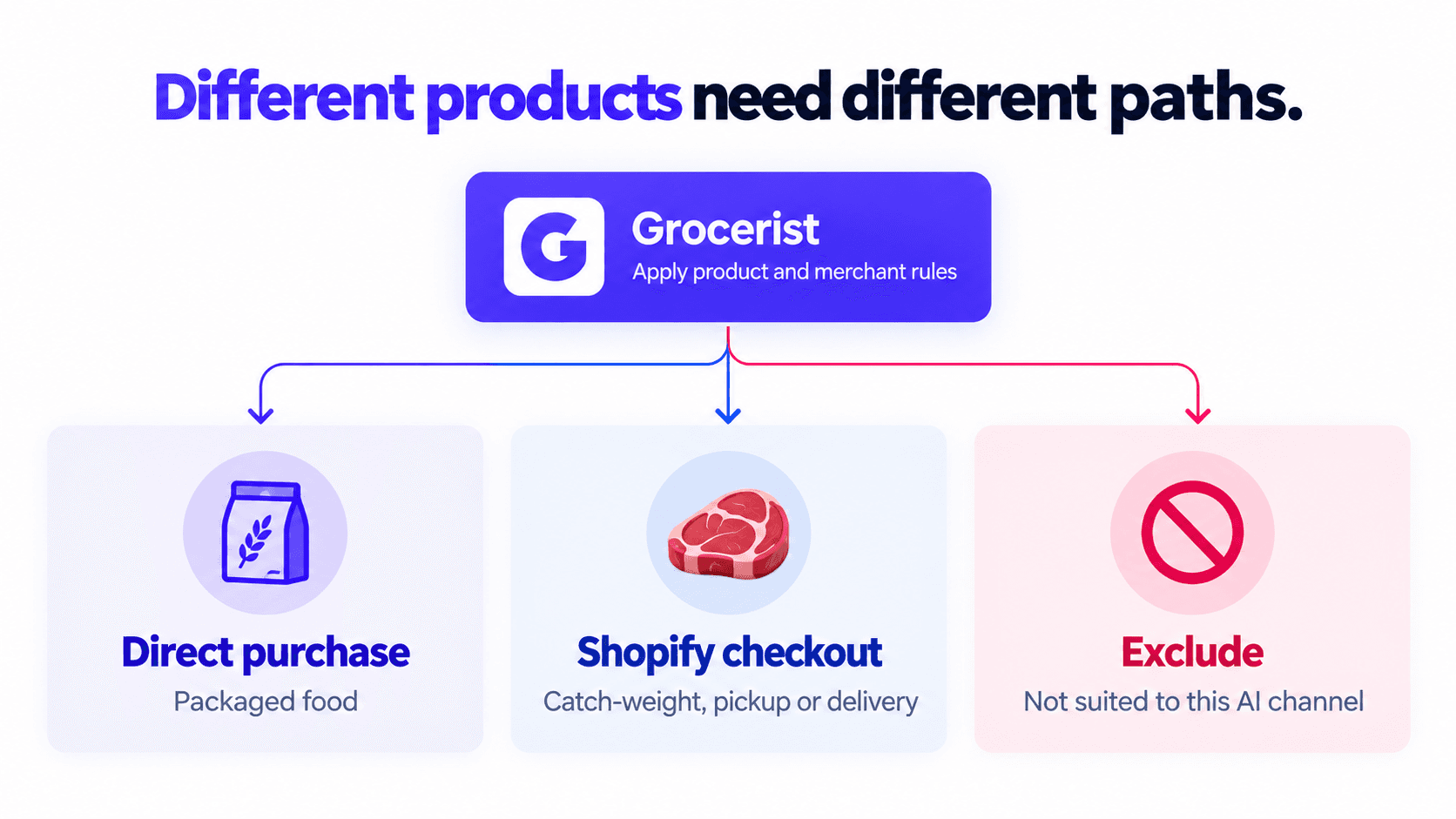
That’s why we believe products will increasingly need different approaches to agentic commerce.
Some products may be discovered and purchased directly within the AI experience.
Others may be discovered through AI, but completed on the merchant’s Shopify store where specialized workflows can take over.
And some products may not belong in a particular AI channel at all.
Pickup and delivery are particularly interesting
Shipping fits relatively naturally into today’s ecommerce model.
Pickup and local delivery are harder.
They introduce service areas, time windows, availability, routing and other operating rules that AI checkout experiences don’t yet handle particularly well.
For many Grocerist merchants, though, pickup and delivery are central to the business.
That doesn’t mean there is nothing to do today.
Discoverability itself is an opportunity.
If AI becomes an increasingly important way for consumers to find products and merchants, being visible and accurately represented in those environments can create value even when the customer still needs to complete the purchase on the merchant’s website.
Being early matters.
We’re testing the margins
At Grocerist, we are intensely focused on the intersection of Shopify + AI + food commerce.
Our job is not simply to follow every new AI announcement.
It’s to continually test the margins between what these emerging platforms can already do and where the complexity of food still requires specialized technology and operating workflows.
Can a normal packaged product complete checkout inside an AI platform?
What happens with catch-weight?
What happens with substitutions?
How should pickup and local delivery work?
Can product data be structured to improve AI discoverability?
When should the customer be handed back to the merchant’s Shopify experience?
Those are the kinds of questions we’re actively working through.
Our goal is simple: help Grocerist merchants capture as much of the sales-growth opportunity created by AI as possible, whether the eventual order is shipped, picked up or delivered locally.
Shopify provides the foundation. Grocerist focuses on food.
One reason we’ve always believed strongly in Shopify is that merchants benefit from Shopify’s continuing investment in commerce technology.
AI is another example.
Shopify can build the infrastructure connecting merchants to a rapidly expanding ecosystem of AI shopping experiences.
Grocerist can concentrate on the food-specific layer: product data, inventory, catch-weight, fulfillment, integrations, pickup, delivery and the operational workflows required to make it all work.
Agentic commerce is still early.
But making food merchants easier for AI to discover and understand is something we can begin optimizing today—while we keep testing what becomes possible tomorrow.