Why Your Ecommerce Technology Partner Should Understand Marketing
Learn why food merchants need an ecommerce technology partner that understands SEO, design, email, analytics, conversion, and long-term growth.
Grocerist
Jul 2, 2026

The best ecommerce platform in the world will not grow a business on its own.
Technology makes online selling possible. Marketing helps the right customers discover the store, understand its value, complete a purchase, and return.
When technology and marketing are planned separately, merchants often end up with a website that technically works but is difficult to find, difficult to improve, or disconnected from the way customers actually shop.
That is why an ecommerce technology partner should understand more than development and integrations. The partner should also understand how design, merchandising, search, content, email, analytics, and conversion work together to create growth.
This belief has shaped Grocerist from the beginning.
Technology is the foundation—not the growth strategy
Launching a functional ecommerce store is an important milestone, but it is only the beginning.
A store can load quickly, process payments, and send orders into fulfillment without generating meaningful revenue. Customers still need a reason to visit, confidence to purchase, and an experience that makes buying food online feel straightforward.
That requires work across several areas:
Storefront design and mobile usability
Search engine optimization
Product merchandising and content
Email and customer retention
Analytics and attribution
Conversion-rate optimization
Digital advertising and campaign landing pages
Ongoing testing and improvement
These are often treated as separate marketing projects. In practice, they are deeply connected to the technology underneath the store.
Marketing decisions affect technical decisions
A technology partner that understands marketing asks different questions.
Instead of asking only whether a feature can be built, the partner also considers:
How will customers discover this page?
What information will help them make a decision?
Can the content be updated without development work?
Will search engines and AI-assisted discovery tools understand the page?
What events and conversions need to be measured?
Can the experience support email, advertising, and remarketing campaigns?
What happens on mobile?
How will the team test and improve the experience after launch?
These questions influence site architecture, page templates, product data, navigation, analytics, integrations, and content-management decisions.
Marketing awareness does not replace technical expertise. It makes technical decisions more commercially useful.

Why Grocerist chose Shopify
Grocerist uses Shopify because it provides a strong commerce foundation and a broad ecosystem for building, operating, and marketing an online business.
Depending on the merchant's plan and configuration, Shopify can support:
Flexible themes and storefront customization
Search-friendly page and product structures
Email campaigns and customer segmentation
Commerce analytics and reporting
Campaign and conversion measurement
Marketing and conversion applications
Integrations with advertising, search, social, and customer platforms
AI-assisted tools and automation
Rather than recreating these general commerce capabilities, Grocerist extends Shopify with the food-specific systems and workflows merchants need.
This lets food businesses benefit from Shopify's commerce and marketing ecosystem while addressing requirements such as variable-weight products, fresh inventory, substitutions, pick-and-pack workflows, pickup, delivery, and operational integrations.
Food ecommerce needs specialized marketing context
Selling food online is not the same as selling a standard packaged product.
Customers may need to understand:
How final pricing works for products sold by weight
Whether substitutions are allowed
Which pickup and delivery options are available
When an order must be placed to meet a fulfillment window
Whether products are available at a particular location
How fresh products are selected, packed, and delivered
These operational details affect conversion. If they are difficult to understand, customers hesitate or abandon the purchase.
A partner that understands both food operations and marketing can turn complex rules into clearer buying experiences. That may involve better product-page language, more useful FAQs, location-aware messaging, stronger merchandising, or more focused campaign pages.
The objective is not simply to explain the technology. It is to make the experience easier to trust and use.
Build a marketing-ready ecommerce foundation
Marketing becomes more effective when the store is prepared to support it.
A marketing-ready foundation should include:
Clear site structure
Products, solutions, audiences, and educational content should be organized so customers and search engines can understand what the business offers.
Reusable landing-page components
The team should be able to build campaign and audience pages without redesigning the site every time.
Complete product information
Useful titles, descriptions, images, categories, and attributes improve merchandising, search visibility, and customer confidence.
Reliable measurement
Analytics should capture the actions that matter, such as product views, add-to-cart activity, checkout progress, purchases, form submissions, and campaign traffic.
Retention capabilities
Email, segmentation and post-purchase communication should help turn first-time customers into repeat buyers.
Fast, accessible experiences
Performance, mobile usability, and accessibility affect both customer experience and the effectiveness of acquisition campaigns.
When these foundations are considered during implementation, marketing teams can move faster after launch.
Launching is the start of the learning cycle
The first version of an ecommerce store is based on research, existing data, operational knowledge, and informed assumptions.
Once customers begin using the store, their behavior provides new information.
The team can learn:
Which landing pages attract qualified visitors
Which products customers view together
Where shoppers leave the purchasing journey
Which search terms and campaigns produce revenue
Which products encourage repeat purchasing
Which questions continue to create hesitation
Which devices or locations experience problems
That information should guide the next round of improvements.
A strong ecommerce partner therefore supports a continuous cycle:
Launch a clear, measurable experience
Observe customer and operational behavior
Identify the highest-impact opportunities
Improve content, design, workflows, or technology
Measure the result and repeat
Growth comes from this ongoing process—not from treating launch day as the finish line.
Work with Grocerist—or keep your existing marketing team
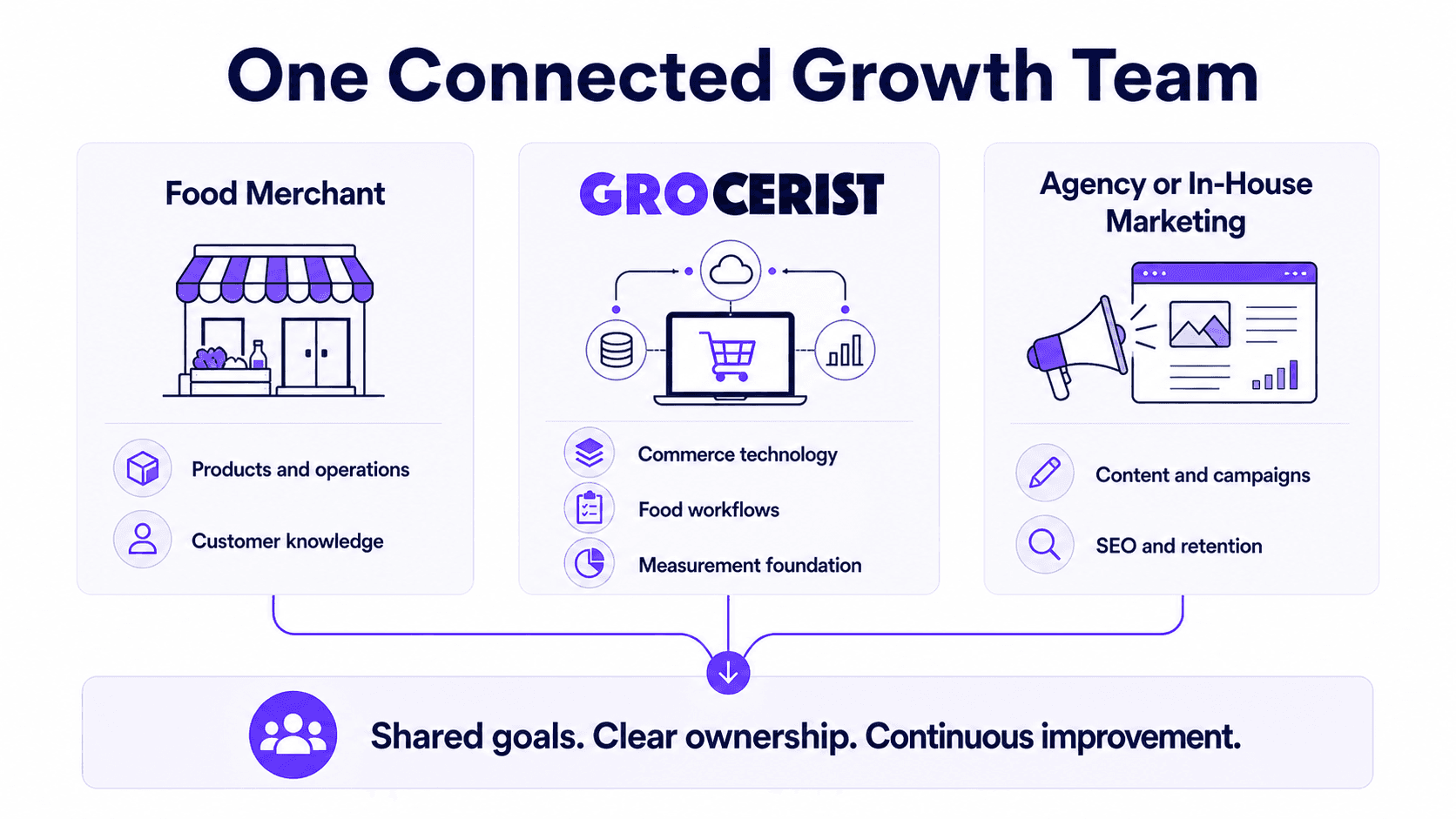
Some merchants want one partner to coordinate ecommerce technology and marketing. Others already have an internal team, a trusted agency, or specialists responsible for different channels.
Grocerist can work within either model.
Depending on the merchant's needs, Grocerist can:
Provide ecommerce and marketing services directly
Collaborate with an existing agency
Support an in-house marketing team
Coordinate with SEO, advertising, email, or creative specialists
Build the technology and measurement foundation those teams need
The goal is not to replace a productive relationship. It is to reduce the gap between the people building the store and the people responsible for growing it.
Clear ownership is important. Each team should understand who controls the storefront, content, product data, analytics, campaigns, testing, and approvals. Shared goals and measurement help everyone make better decisions.
Marketing experience shaped Grocerist
Before founding Grocerist, two of the company's co-founders ran a digital agency. Their work included website design, search visibility, lead generation, and online growth.
That experience influenced how Grocerist approaches food commerce.
The platform must support operational complexity, but the customer experience must remain clear. The technology must connect with existing systems, but it should also give marketing teams useful content, data, and tools. The store must launch successfully, but it should also be able to improve over time.
This combination of food-commerce technology and marketing perspective helps merchants build an online channel designed for more than transactions.
It is designed for long-term growth.