Beyond the Storefront: The Operational Data Challenge Behind Modern Ecommerce
Learn how connected ecommerce workflows link Shopify with POS, spreadsheets, accounting and reporting to reduce manual work and improve accuracy.
Grocerist
Jul 21, 2026
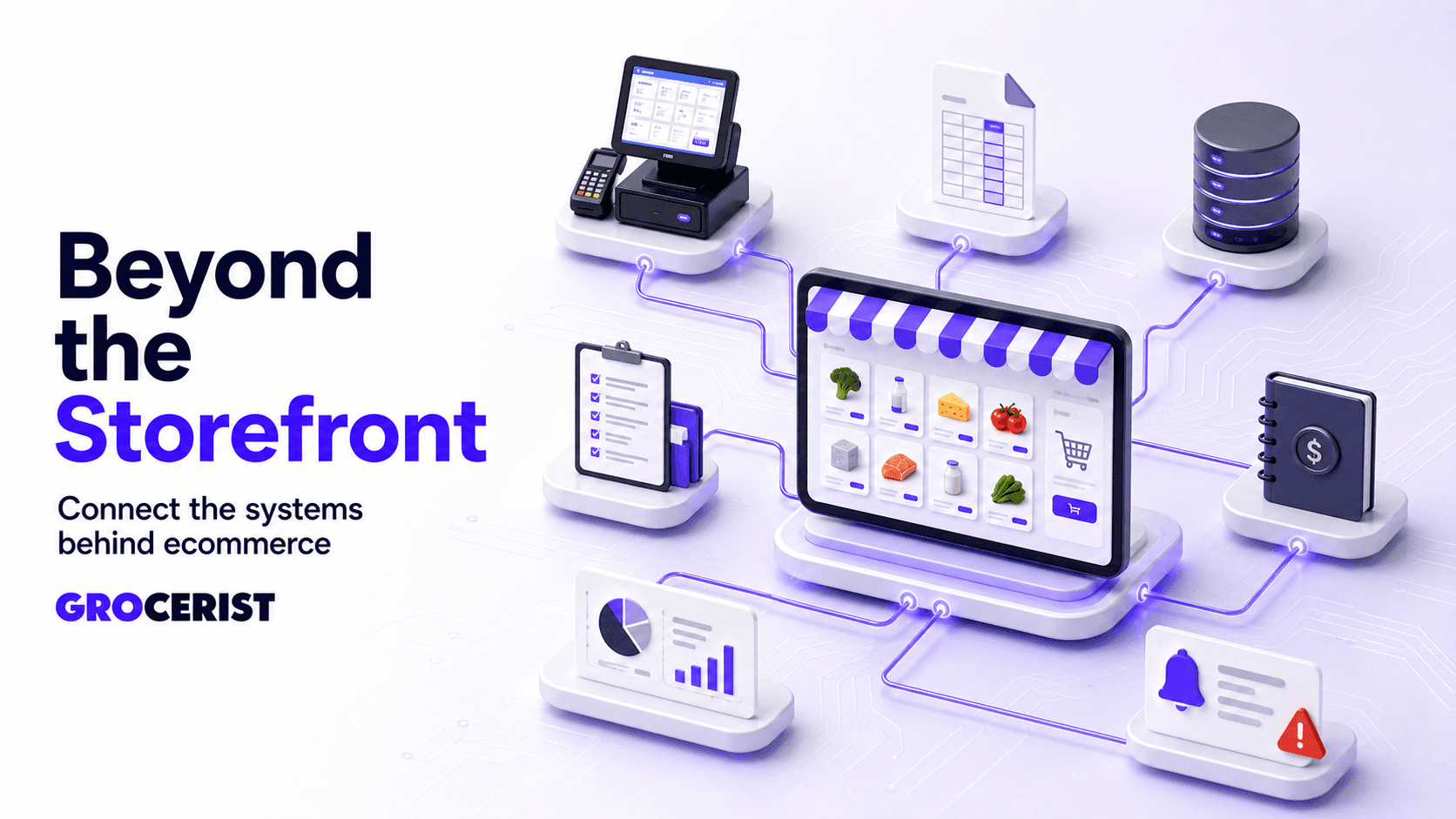
Launching an ecommerce site is often the most visible part of a much larger technology challenge.
Behind the storefront, a merchant may manage inventory in a point-of-sale system, pricing in a spreadsheet, accounting in QuickBooks, product information in vendor files and reporting in yet another application. Employees then spend time downloading exports, reformatting files, copying values, resolving discrepancies and moving information between systems.
Each system may work well on its own. The operational problem is the manual work required to make them work together.
That is where ecommerce workflow automation can create value. Rather than forcing every process into one platform, a connected data layer can validate, transform and route information between the tools a business already uses and the systems that support its online channel.
The goal is not to add another disconnected system. It is to reduce repetitive work, improve data accuracy and make Shopify part of a broader commerce operation.
The storefront is only one part of ecommerce
A customer sees products, prices, availability and checkout. The merchant must support everything behind that experience.
That may include:
Product and variant data
Inventory from one or more locations
Pricing and promotional rules
Vendor files and purchasing information
Fulfillment and delivery workflows
Accounting-ready order data
Recurring operational and management reports
When those responsibilities are distributed across several systems, staff often become the integration layer. They copy information from one place to another and use spreadsheets to bridge gaps that software does not address.
This approach can work for a time, but it becomes harder to maintain as order volume, product count and operational complexity increase. A missed file, changed column or mismatched SKU can affect availability, pricing, reporting or fulfillment.
A connected workflow replaces those fragile handoffs with an intentional data flow. Source information is retrieved, checked, prepared and sent to the appropriate destination according to the merchant's operating rules.

The spreadsheet is not necessarily the problem
It is easy to assume that a business running important processes through Excel or Google Sheets needs a new ERP, inventory platform or reporting system.
Sometimes it does. But spreadsheets often contain years of useful operating knowledge: pricing logic, inventory calculations, product mappings, reporting structures and processes that employees understand.
Replacing those tools may create cost and disruption without addressing the actual bottleneck. The better question is:
Which systems and processes should remain, and which manual steps between them should be automated?
Modern integrations can retrieve data from POS systems, SFTP locations, accounting software, ERPs, databases, vendor files, spreadsheets, Shopify and other applications. A workflow can then validate and transform that information before routing it to the systems that need it.
This allows a merchant to preserve useful processes while removing repetitive work around them.

Food commerce is a demanding proving ground
Grocerist has encountered these challenges in one of the more operationally complex areas of ecommerce: food retail and wholesale.
Food inventory is not always managed as simple units. Products may be sold by weight, actual weights may not be known until fulfillment, availability can change quickly and pricing or cost information may originate in several systems.
The data a food business needs to operate is also not always the same data Shopify needs to present and sell a product.
That requires thinking beyond the storefront. Grocerist connects operational systems with Shopify through configurable inventory and data workflows that can account for information such as:
Product availability
Inventory quantities
Pricing and costs
Average or actual weights
Merchant-specific availability rules
Order and fulfillment updates
The same principles apply outside food. Wherever employees repeatedly move data between systems, there may be an opportunity to create a more reliable workflow.
Where ecommerce workflow automation creates value
Inventory synchronization is one application, but it is not the only one.
Inventory synchronization
Retrieve inventory from a POS, ERP, warehouse system or spreadsheet, apply ecommerce-specific availability rules and update Shopify automatically.
Pricing automation
Receive approved pricing from an operational source, validate it, apply business rules and publish the correct value to Shopify.
Product data management
Consolidate SKUs, UPCs, costs, attributes and other information from several sources, then distribute the appropriate fields to each destination.
Recurring reporting
Combine Shopify, POS, inventory and cost data to prepare recurring sales, inventory, margin or management reports.
Accounting workflows
Structure ecommerce orders, payments, refunds and adjustments for accounting without repeatedly manipulating exported files.
Vendor and purchasing data
Import vendor files, standardize product or cost information, identify exceptions and incorporate updated data into the merchant's existing processes.
The technologies involved may include APIs, SFTP, databases, spreadsheets, native integrations or workflow tools such as n8n and Zapier. Technology, however, should not be the starting point. The starting point is understanding how the business operates.

The most valuable opportunities can be surprisingly ordinary
Automation does not need to begin with a major transformation project.
Consider the work employees perform routinely:
Downloading the same CSV every morning
Reformatting a weekly report
Copying data between spreadsheets
Updating Shopify inventory manually
Reconciling mismatched SKUs
Preparing the same management report every Friday
If a recurring task consumes five hours each week, it represents roughly 260 hours of manual work each year. Removing that work can create meaningful value without forcing the merchant to redesign the entire operation.
These ordinary processes are often strong starting points because they are repeatable, measurable and familiar to the people doing the work.
Reliable automation requires more than moving data
Connecting two systems is only part of the challenge.
A workflow a business can depend on must also answer questions such as:
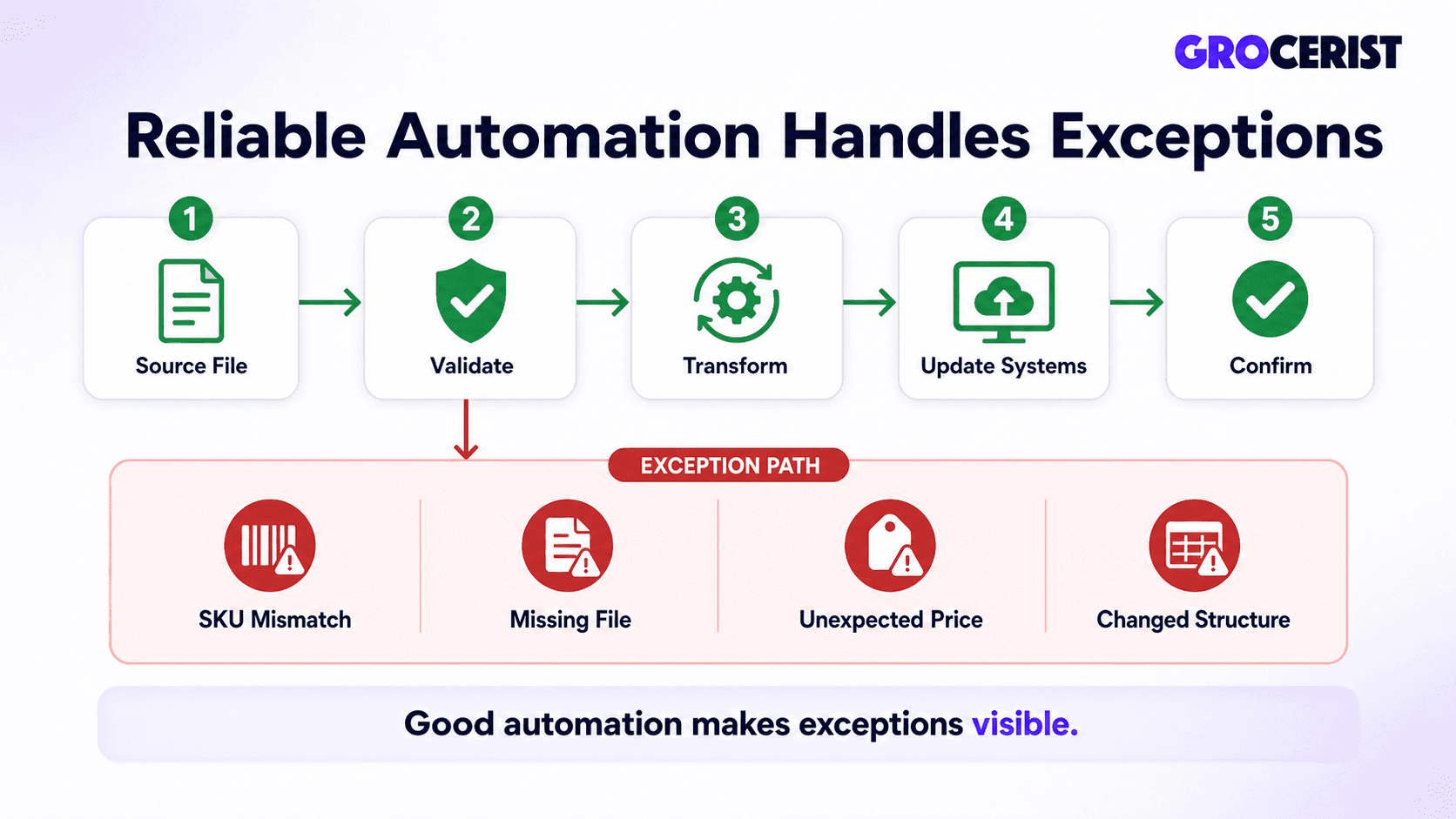
What happens when a SKU does not match?
What if an expected file does not arrive?
What if a price is zero or far outside its expected range?
What if a spreadsheet structure changes?
Who should be notified when a workflow fails?
Can the process stop safely before incorrect data reaches customers?
Dependable automation requires validation, business rules, exception handling, alerts and visibility.
The objective is not simply to automate the happy path. It is to make problems visible and give the team a clear way to respond when something changes.
Good automation reduces the number of successful transactions employees must inspect manually while directing their attention to the exceptions that genuinely require judgment.
Ecommerce expertise increasingly includes operations
Ecommerce agencies have traditionally focused on customer-facing disciplines such as design, development, conversion, merchandising, SEO and marketing. Those capabilities remain important.
But Shopify increasingly sits within a wider operational environment that may include POS systems, accounting software, ERPs, warehouse systems, vendor feeds, spreadsheets and custom databases.
Understanding Shopify is one capability. Understanding how Shopify should participate in the merchant's broader operation is another.
That work requires ecommerce knowledge, data analysis, systems thinking and an understanding of how real teams use information every day.
Start with the process, not the platform
One of the most useful questions a merchant can ask is:
What spreadsheets, files or reports does someone on our team update manually every day or every week?
Then trace the process:
Where does the information originate?
Who changes or approves it?
Which rules are applied?
Where does the information go next?
Why is human intervention required?
What exceptions need to remain visible?
The answers often reveal where automation can have the greatest impact.
The right solution should not force a merchant to manage another isolated platform. It should connect the systems the business already uses, automate the steps that are consistent, expose exceptions and preserve human involvement where judgment matters.
Connect the work behind your storefront
Businesses accumulate systems, and systems accumulate data. Eventually, someone has to make all of it work together.
As ecommerce becomes more connected to inventory, finance, fulfillment and reporting, improving the flow of operational data is becoming as important as improving the storefront itself.
Grocerist developed this approach by solving complex food-commerce workflows, but the underlying opportunity is broader: connect existing systems, reduce repetitive work and build a more dependable operation around Shopify.